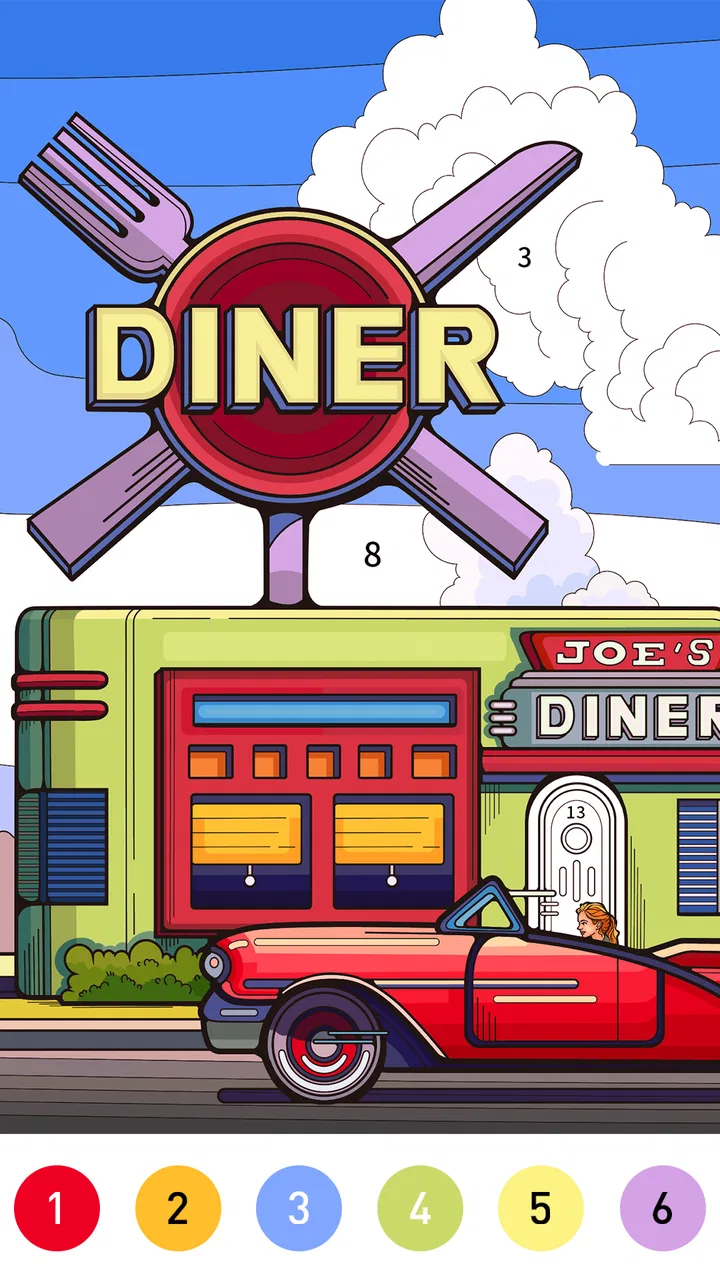
Nostalgia Color by number game
- 4.4
- Rating
- 1.00M
- Installs
- Free
- Price

 Analysis by App-foxy
I found Nostalgia Color to be a gentle number-coloring game built around familiar memories rather than fast competition. It sits in the board-game category, but it feels closer to a quiet digital coloring book: choose an image, follow its numbered sections, and gradually turn a plain outline into a finished scene. That simple rhythm is the main reason to try it. It gives you something small to do when you want to relax, without demanding the concentration of a strategy board game or the speed of an arcade title.
The game comes from Art Coloring Group and is free to start. It is rated for Everyone, which makes the presentation approachable for a broad audience, including people who do not normally play games. Its current version is 1.2.9, and it runs on Android 7.1 or later. The listing shows a 4.5 average from around 6,100 ratings, with more than a million installs, so it has clearly reached a substantial audience without being positioned as a premium-only experience.
How the coloring experience feels in everyday use
My first impression was that the game understands the appeal of repetition. The basic action is not complicated: I look for a number, select the matching color, and tap the corresponding areas. That may sound almost too simple, but the process has a useful sense of progress. A picture that begins as a collection of blank shapes slowly becomes recognizable, and that change gives each short session a clear ending point.
You May Also Like

 Blood Strike: 2.5 Anniversary
Blood Strike’s Loadouts Turn Every Drop Into a Tactical Gamble
A close look at Blood Strike’s custom loadouts: how fast access to signature weapons reshapes its battle royale rhythm, rewards preparation, and narrows the gap between fights.

 Pandora - Music & Podcasts
Pandora’s Music Is Easy to Start, but Harder to Recover
Pandora’s strength is its low-effort path from a seed to a station. Its weak spot is how much confidence it asks you to place in connection, setup, and quiet recovery.

 8 Ball Pool
 Is Built on Rivalries, Rematches, and Routine
A close look at the rivalries, rematches, shared routines, and unanswered safety questions that turn a quick pool match into a persistent mobile community.

 Samsung Music
’s Quiet Strength Is Playing What You Already Own
Its reach comes less from spectacle than from dependable access to a personal library. That simplicity is both the app’s strongest retention engine and its ceiling.

 AccuWeather: Weather Radar
AccuWeather Review: A Quick, Clear Forecast for Everyday Decisions
For everyday plans, the best forecast is the one you can understand quickly. AccuWeather makes rain timing, radar, and local conditions easy to act on, with a few trade-offs.

 Hill Climb Racing
Why Hill Climb Racing Still Turns Crashes Into One More Run
A tiny car, a bumpy hill and one more upgrade: Hill Climb Racing keeps resurfacing because its simple chaos makes every near-miss feel personal.
More From Our News Desk



The nostalgia theme also affects how I approach the pictures. Instead of treating every image as an abstract puzzle, I tend to connect the scenes with familiar objects and moments. That makes the activity feel more personal than an ordinary color-by-number exercise. It is a good fit for a quiet break, a few minutes before bed, or a low-pressure activity while listening to music or a podcast.
I would not describe it as a traditional board game despite its store category. There is no need to plan several moves ahead, manage a hand of cards, or compete with another player. If you are searching for tactical decisions, multiplayer interaction, or a strong win-and-loss structure, this is not the right interpretation of “board.” Its appeal comes from completion and atmosphere, not from strategic depth.
A practical routine for finishing pictures
I got better results by treating each image as a small project instead of trying to complete it in one sitting. I start with the larger, easier sections because they establish the main colors quickly. Then I work through the smaller areas, where the task becomes more about careful scanning than creativity. This approach reduces the feeling of searching randomly across the whole picture.
One useful habit is to change the way I scan the image. Rather than tapping around the screen hoping to find the next matching section, I move from one edge toward the center and check each area systematically. That is especially helpful when several tiny spaces share a number. It turns a potentially irritating hunt into a simple routine and makes the game more comfortable on a smaller phone screen.
When I am tired, I avoid treating missed taps as a personal failure. Number-coloring games naturally involve small targets, and accuracy can become harder when the image contains many narrow shapes. Slowing down is usually more effective than repeatedly tapping the same place. The experience works best when I accept that the goal is calm completion, not speed.
Where the free experience fits
The game is free to download and play, while the listing shows optional in-app purchases ranging from $0.99 to $59.99 per item. That range matters when judging value. Free access lets you decide whether the coloring loop and nostalgic presentation suit you before spending anything, which is a meaningful advantage for a casual game.
At the same time, I would not assume that every part of the experience has the same value for every player. Someone who only wants occasional pictures can reasonably stay with the free portion and treat the game as a light pastime. A more committed player may place greater value on convenience or additional content, but that decision depends on how often the game is used and how strongly the available purchase options appeal to that person.
My advice is to evaluate the free experience first. Do you enjoy locating the numbered areas after the initial novelty wears off? Do the images make you want to return, or do you finish one and feel done? Those answers are more useful than the size of the purchase range alone. Because the game costs nothing to begin, there is little reason to decide on paid value before understanding your own habits.
The free starting point is also helpful for families. Since the content rating is Everyone, the concept is easy to explain and does not rely on complicated rules. Still, I would guide younger players through any purchase screens and make sure they understand that an optional item can cost real money. The age rating describes the content, not how a household chooses to manage spending.
What the game does well
The strongest quality is its low barrier to entry. I do not need to learn a long tutorial, memorize rules, or build a strategy before enjoying the first image. The numbered format gives enough direction to remove the pressure of choosing colors, while the gradual reveal provides a small reward for persistence.
That makes it particularly suitable for people who want a game with a predictable pace. It can fill a short waiting period without requiring a commitment to a long level or an online match. It also works for players who like visual completion: the satisfaction comes from seeing blank spaces disappear and the picture become coherent.
Another strength is that the nostalgia angle gives the activity a clearer identity than a completely generic coloring app. The theme encourages me to pause over the finished image rather than immediately move to the next task. Even when the mechanics remain simple, the subject matter can make the result feel more memorable.
There is also a useful difference between this and free-form coloring. In a blank canvas app, I have to decide the palette, balance the composition, and accept responsibility for the final look. Here, the numbered structure removes those decisions. That is a benefit when I want relaxation rather than self-expression, although it is a limitation if I want to create something genuinely personal.
The tradeoffs I noticed
Its simplicity can become repetitive. The same basic cycle—find a number, choose the matching color, tap the section—does not develop into a deeper challenge in the way a puzzle game might. If you need new mechanics, strategic choices, or a sense of increasing mastery, the number-coloring format may feel narrow after several sessions.
The game is also not ideal when you want a creative outlet. It gives structure, but that structure controls the result. I can decide which area to complete first, yet I am not really designing the image. For artistic experimentation, a drawing app or an open coloring tool would offer more freedom. For competitive entertainment, a conventional board game would provide more meaningful decisions and interaction.
Small details can demand patience. Narrow sections and repeated numbers make the experience less comfortable when I am rushing. I recommend using a larger screen when possible and taking short pauses during detailed pictures. This is not a criticism of the concept so much as a reminder that “relaxing” does not always mean effortless; careful tapping can still become tiring.
The purchase structure deserves a measured view too. The game is free, but optional items can cost from $0.99 up to $59.99 each. That does not make the free version poor value, but it does mean I would avoid buying impulsively simply because I enjoy the first few images. I would first decide whether I expect regular use, whether the extra value is clear to me, and whether the purchase fits my personal budget.
I also would not choose this game for a social occasion where several people want to play together. Its strength is individual focus. Passing the phone around or watching someone else color does not create the same involvement as a multiplayer board game. It is better as a personal wind-down activity than as the center of a group gathering.
Who is most likely to enjoy it
I think the best audience is anyone who likes calm, guided activities and wants a recognizable visual result without having to make artistic decisions. It can suit a casual player who has only a few minutes at a time, a coloring fan who prefers numbered prompts, or someone looking for a less demanding alternative to action games.
It may also work well for relatives who are comfortable with simple touch controls but do not want complex game systems. The Everyone rating supports that broad accessibility, while the familiar-memory theme gives the pictures an emotional hook that a purely abstract set might lack.
A realistic everyday scenario would be using it during a short evening break. I might finish a small section while waiting for dinner, return later, and complete the image before going to bed. Because the game does not require me to remember a complicated storyline or maintain a competitive ranking, stopping and restarting feels natural. That makes it more practical than a game that punishes interruptions.
On the other hand, I would steer competitive players toward a proper board or puzzle game. If your ideal session includes a difficult objective, clever tactics, or a clear way to improve your score, this title may leave you wanting more. I would also suggest a free-form coloring app to anyone who mainly wants to choose their own colors and create an original composition.
How it compares with familiar alternatives
Compared with traditional board games, this is far easier to start but much lighter in decision-making. A physical board game can create conversation, tension, and unexpected outcomes between players. Nostalgia Color offers none of that social structure, but it also avoids setup, cleanup, missing pieces, and the need to find an opponent.
Compared with ordinary digital coloring apps, its numbered system is more guided. That can be ideal when I want a guaranteed path toward a finished image, especially after a long day. The tradeoff is reduced control: I cannot freely reinterpret the picture in the same way I could with a blank digital canvas.
Compared with puzzle games, it is less mentally demanding and more repetitive. That is not automatically a weakness. If I want to rest my attention rather than challenge it, the simpler format is exactly the point. But anyone expecting increasingly complex puzzles should choose a game built around deduction, matching, or planning instead.
The most important comparison is therefore about mood. This is a better choice when I want quiet progress, visual completion, and a nostalgic tone. Another option is better when I want competition, social play, artistic freedom, or substantial mechanical variety.
My verdict on value and whether to download
Art Coloring Group has made a focused, accessible coloring game rather than an ambitious strategy title, and I think that focus works. The free entry point makes it easy to test, while the Everyone rating and Android 7.1 minimum make it approachable for a wide range of devices and players. Its 4.5 average and more than a million installs suggest that the format has found an audience, though popularity alone should not decide whether it suits you.
I would recommend trying it if you want a peaceful activity that can be paused at any time, especially if nostalgic images appeal to you. Start without spending money, complete enough of the free experience to see whether the repetition remains pleasant, and only then consider whether an optional purchase offers personal value. The listed purchase range is broad, so I would judge each choice carefully rather than treating paid content as automatically necessary.
I would skip it if you are looking for a competitive board game, a deep puzzle system, or a tool for unrestricted creativity. Those needs are better served elsewhere. For everyone else, the game is a sensible free download to test during a quiet moment. Its real value is not complexity; it is the reliable, low-pressure satisfaction of turning a numbered outline into a finished memory.
FAQs for Nostalgia Color by number game
01What is Nostalgia Color by Number and how does it work?
Nostalgia Color by Number is a relaxing puzzle game where players fill in pixelated images with colors based on a number system. Each image is divided into small squares, each marked with a number. Players select the corresponding color and apply it to the squares, gradually revealing a complete image. It’s a fun and therapeutic way to unwind and explore your creativity.
02Is Nostalgia Color by Number free to play?
Nostalgia Color by Number is free to download and play, offering a wide range of free images to color. However, the game includes optional in-app purchases that provide additional features, such as ad removal, exclusive image packs, or faster coloring tools. These purchases enhance the gaming experience but are not required to enjoy the game.
03What devices are compatible with Nostalgia Color by Number?
Nostalgia Color by Number is available for both Android and iOS devices. It requires Android version 4.1 or later and iOS version 9.0 or later. The game is optimized for both smartphones and tablets, ensuring a smooth gaming experience across different screen sizes and resolutions.
04Are there any age restrictions for playing Nostalgia Color by Number?
Nostalgia Color by Number is suitable for players of all ages. Its simple, intuitive interface makes it accessible to children, while the intricate designs and variety of images cater to adult players seeking a relaxing pastime. Parents can rest assured that the game is family-friendly and does not contain inappropriate content.
05Can I play Nostalgia Color by Number offline?
Yes, Nostalgia Color by Number offers offline play, allowing users to enjoy the game without an internet connection. This feature is particularly useful for those who want to play while traveling or in areas with limited connectivity. However, some features, like downloading new image packs, may require an internet connection.
Pros
- Easy to use for all ages
- Large variety of images
- Offline mode available
- Regular updates with new content
- Relaxing and stress-relieving
Cons
- Ads can be intrusive
- Limited free content
- Requires in-app purchases
- Some images are complex
- Occasional loading delays

Nostalgia Color by number game
Gallery